|


Enjoying the great outdoors is really what it's all about. So after hiking 5 km along the Carrot River in Spring 2006, only to find we couldn't reach the fossil quarry on the other side because the river was too high, we were only mildly disappointed. After all, we'd discovered another fine Saskatchewan regional park and we enjoyed hiking the Andy Jamault Trail.
Besides, we learned long ago to expect the unexpected during early season camping in Saskatchewan. It's unlikely the trail has improved much this year, given the flooding this spring (2007).
 |
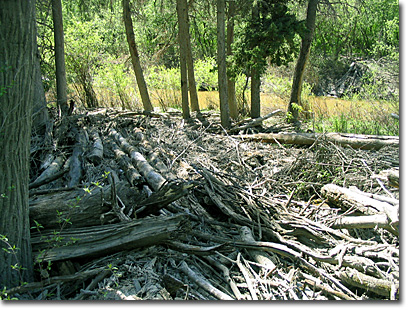
| Flood waters had begun to recede, but it was pretty messy at trail's edge. |
Our quest was Big Bert. Or better put: our quest was Big Bert's last natural resting place.
It was back in 1991 that a team from the Royal Saskatchewan Museum (RSM), guided by local fossil hunter Dickson Hardie, unearthed the fossilized remains of a huge crocodile from a shale formation about seven metres above the riverbed. The Terminonaris crocodile, a marine reptile who has come to be known as Big Bert, measured about 7.6 m (25 ft) long. Big Bert is considered to be
the most complete fossilized Terminonaris specimen in the world.
From what palaeontologists know about Bert, he likely fished and roamed the shallow waters near the eastern shoreline of the saltwater sea that covered much of the central part of North America about 90 million years ago. The area where Bert was discovered has revealed a wide assortment of fossils, including those of plants, birds, sharks, bony fish, dinosaurs, turtles and plesiosaurs—these are the guys with the small heads, long necks and four paddle-like limbs. It's a place where the river cuts through ancient sediments revealing layers of the hardened clay known as shale, as well as volcanic ash and coal.
A glossy pamphlet extolling the virtues of Pasquia Regional Park (and yes, that's "Pasquia'', not "Pasqua'', although it's pronounced the same) devotes a majority of its textual content to Big Bert and what park officials no doubt hope will become an attraction that draws tourists to the region. Something like what "Scotty'' the T.rex has done for Eastend, in southwest Saskatchewan. The pamphlet proclaims: "The quantity and quality of fossils in this area are the best in Canada. Bird fossils of some species are the oldest of their kind in North America . . . Two fish skeletons found there may the oldest of their kind in the world.''
Pasquia park manager Susan Schroepfer is pleased the province designated the dig area a provincial heritage site in 1995. It means that no other museums or universities can remove fossils from the location. However, she has concerns Mother Nature may not be so easily restrained.
"There's another crocodile down there, and there's a montasaur, too,'' says Schroepfer. "If they don't come for them pretty soon—with all the high water we've had—it's going to be washed away.''
A small interpretive centre in the park provides more information on Bert. But you can see a fair bit from where you're sitting right now by visiting the website operated by the Town of Carrot River. The Royal Saskatchewan Museum, which also operates the RSM Fossil Research Station located in the T.rex Discovery Centre at Eastend, also has information on the Pasquia discoveries.
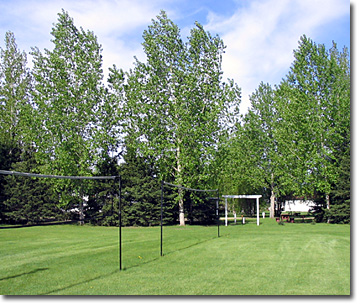 |
| There's camping around part of the permimeter of the central recreation area that features a creative playground and volleyball nets. |
Pasquia Regional Park is a handsome and well-organized facility. The large, well-equipped and well-manicured play area is bordered on three sides by campsites, while an outdoor pool and golf course lie beyond the fourth. There are several rows of campsites running parallel to the west side of this commons area and one long row of sites running down the north end of the campground. I prefer a little more privacy than what's afforded by the younger pines that separated us from our neighbouring campers on the perimeter of the play area. But this is a minor complaint that time will eliminate. And young families, especially, will appreciate these campsites that share the perimeter of a large play area. There's no wondering what the kids are up to; the large play area lies just a few metres from each perimeter site. Youth and adults can enjoy two volleyball courts at one end of this commons—each boasted a taut, new net at the time of our visit.
The clean shower house (hot water and flush toilets) is located amid the rows of campsites. White, wooden archways strategically located at several points in the campground channel foot traffic along proscribed pathways, rather than allowing people to meander through others' campsites. The wood supply during our spring visit was enormous and the logs were well seasoned and dry. Camping fees were $14 and $18 for non-electrical and electrical, and there's $6 park entry fee. That might seem a touch high for a regional park, however, the fees are appropriate for the services, facilities and well-maintained grounds we experienced at Pasquia.
 |
| The view across the golf course toward the traihead. |
"One of the most challenging nine-hole golf courses in Saskatchewan'' is how the literature describes the grass-greens and irrigated fairways of Pasquia Golf Course. The course benefits from the undulating river valley adjacent to the campground, but the cost of this beautiful setting became apparent during spring flooding. We were told there was much clearing to be done when the waters receded. A clubhouse, pro shop and licensed restaurant are just a few features of this course.
Postscript: Sadly, northeast Saskatchewan is undergoing heavy flooding again this spring (2007). So it's likely a good idea to call the park first to find out how the golf course and trail are holding up.
Pasquia Regional Park's season runs from May 1 to Sept. 30, every year.
Contact Us
| Contents |
Advertising
| Archives
| Maps
| Events | Search |
Prints 'n Posters | Lodging
Assistance | Golf |
Fishing |
Parks |
Privacy |
© Copyright (1997-2012) Virtual Saskatchewan
|